

Today, assembly automation requires an increasingly higher level of precision, reliability, and adaptability.
Machine design is moving toward interconnected architectures where process data is used for continuous performance monitoring, deviation detection, and process stability improvement.
After-sales service has also evolved, integrating advanced tools to monitor system performance and support its continuous improvement.
AI-based Anomaly Detection algorithms allow for the early identification of anomalous behaviors, transforming collected information into concrete predictive maintenance actions and improving the operational efficiency of the systems.
This is the direction Sinteco pursues: developing solutions capable of reducing machine downtime, increasing production reliability, and contributing to the achievement of increasingly high standards of industrial efficiency.
With this in mind, the collaboration between Sinteco and the University of Padua has given life to an innovative predictive solution within a research and development project.
This system, in addition to monitoring machine status, is able, thanks to an advanced algorithm developed internally, to learn and anticipate potential anomalies, preventing machine downtime before it becomes problematic.
We are not talking about simple automation, but a true generational breakthrough: the heart of this system pulses thanks to machine learning technologies.
This architecture thinks and evolves, redefining the very concept of the smart factory and bringing industrial efficiency directly into the future.
The foundation of the system: anomaly detection and algorithms applied to automation
The distinctive element lies in the anomaly detection approach, which allows for the automatic detection of anomalies in machine behavior, without the need for manual intervention.
The algorithm continuously learns from the operational behavior of the machines, analyzing data in real time. In this way, the system dynamically adapts to variations in operating conditions, improving its predictive capacity without having to be programmed for every single situation.
The real quantum leap lies in the fact that anomaly detection does not travel on traditional tracks, but integrates advanced AI and edge learning algorithms. This means that intelligence does not reside only in a remote server, but is processed instantly on board the machine, on the edge.
That is, the machine learns locally and in real time, ensuring immediate reactions and data privacy protection.

The learning and analysis process
The operational flow is divided into four main phases:
1. Identification of significant data
The first step consists of identifying the most relevant parameters for machine operation and collecting this data continuously. The collected data is sent to a centralized system for efficient management and analysis.
2. Data cleaning and filtering
During this phase, unhelpful or redundant data is eliminated, preparing the dataset for proper analysis.
3. Learning and neural training
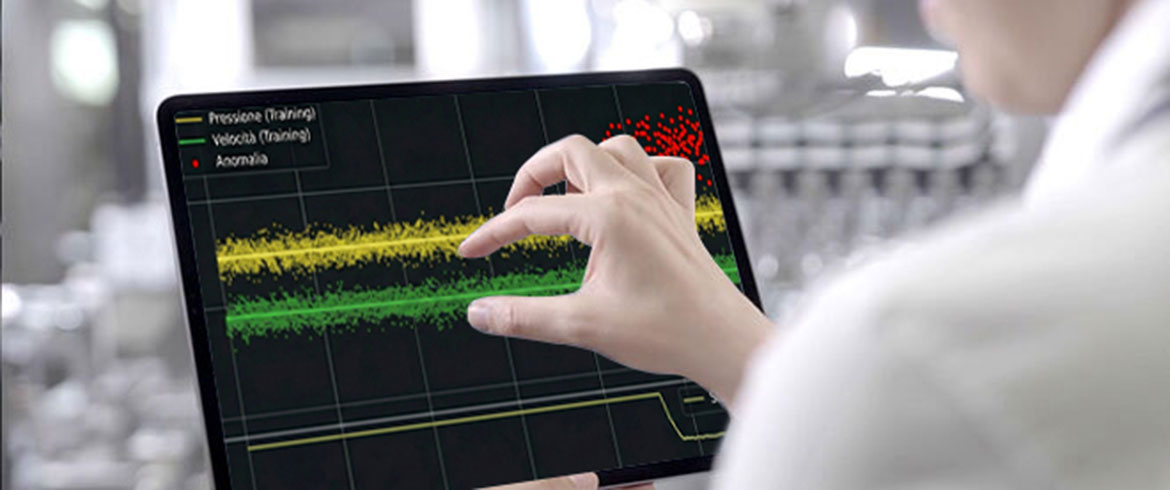
Once the data is cleaned, machine learning comes into play. The algorithm starts a deep training phase, analyzing historical patterns and real-time flows to map the ideal behavior of the machine, successfully recognizing microscopic anomalies invisible to the human eye.
4. Prediction
Any drifts are reported, highlighting the indicators causing the change.